Dev blog · Best of · 2026-11-20 · updated 2026-11-25
The best AI tools for DevOps and cloud in 2027
Coding agents got good at writing application code first. Infrastructure is catching up. Most of the big cloud providers now publish official MCP servers or agent plugins, and the community has filled the gaps for Kubernetes, Docker and monitoring.
These are our picks for 2027, from Calyban’s catalog. How we picked: the official tool from each provider where one exists, then the most-used community option, then skills that encode real operational practice.
One warning before the list, because it matters more here than anywhere else. An agent connected to your cloud account can change your cloud account. Start every one of these with read-only credentials, a staging environment or both. Give it write access when you’ve watched it work for a while, not before.
Give ops its own agent
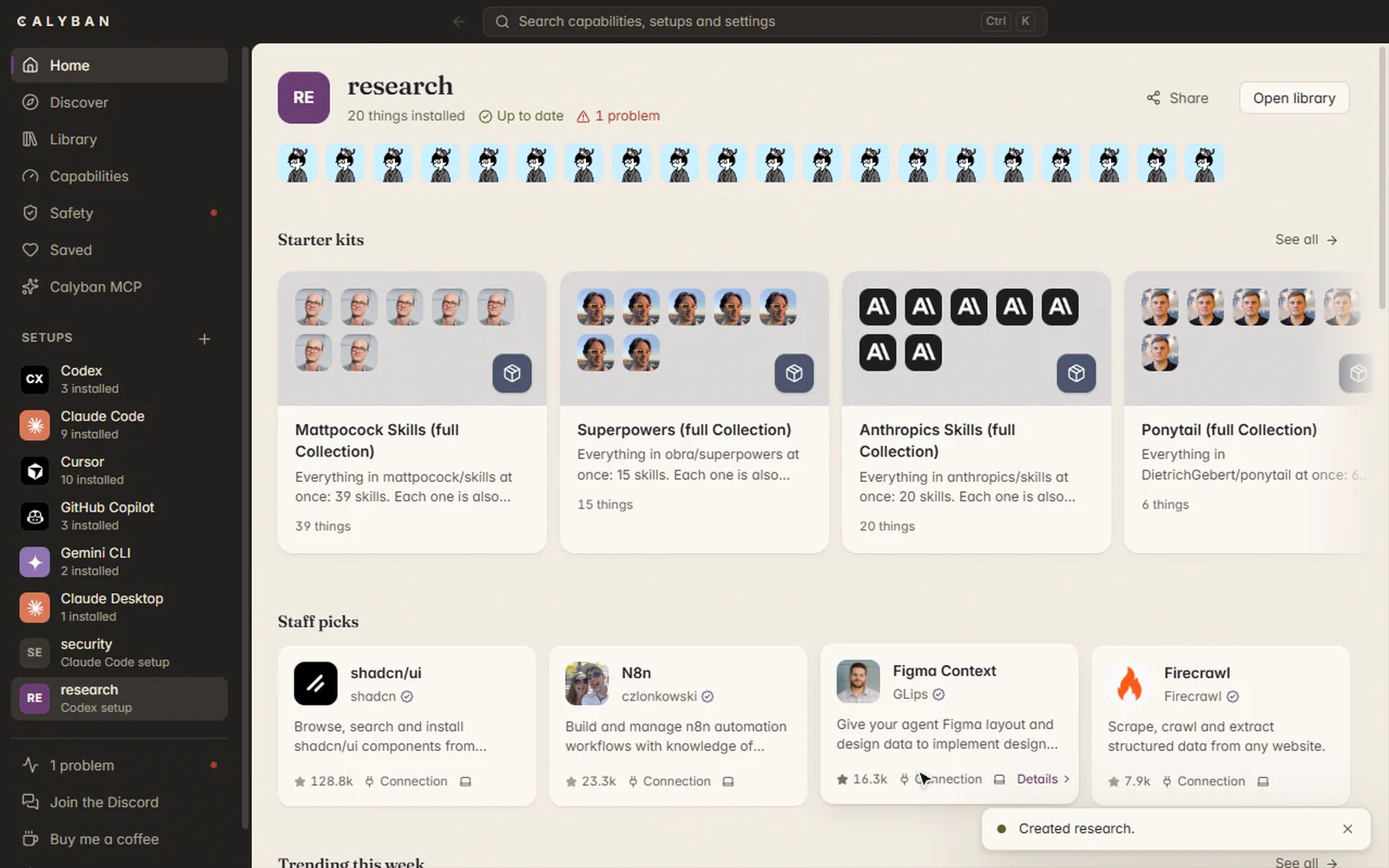
The best advice we have for agents and infrastructure: keep them in their own box. Calyban, the free app we make, has Setups, which are separate copies of Claude Code or Codex. Each has its own MCP servers, skills and instructions, and switching one never touches the others.
Make an “ops” setup with your cloud and monitoring servers, and your everyday coding agent never sees those credentials. Each setup can start from the terminal under its own name, like codex-ops.
Starter kits fill a setup in one click. Cloudflare & Edge installs Cloudflare’s official skills for Workers, Wrangler, Durable Objects and the Agents SDK. Blue Team brings Sentry, Snyk and incident-response helpers.
Cloud providers
AWS Core (Amazon Web Services, Claude Code plugin). Skills for building, deploying and running applications on AWS: infrastructure-as-code, the core services and common tasks. Same publisher has AWS Agents for building agents on Bedrock AgentCore and an AWS data analytics plugin.
Azure MCP Server (Microsoft, official). Azure’s tools in one server: resources, storage, databases, monitoring and more. Microsoft also publishes an Azure plugin that pairs the server with skills.
Cloudflare (Cloudflare, official plugin). Skills for Workers, Durable Objects, the Agents SDK and Wrangler, plus Cloudflare’s MCP server. If you only want the docs, the Cloudflare Docs server is read-only and needs no account.
Heroku (Heroku, official). Apps, add-ons, dynos and databases, for teams who’d rather not think about any of the above.
Infrastructure as code
Terraform (HashiCorp, Claude Code plugin). HashiCorp’s Terraform MCP server, which gives the agent current provider and module documentation from the Terraform Registry. That’s the fix for the most common Terraform mistake agents make: writing a resource argument that was renamed two provider versions ago.
Terraform Patterns (affaan-m). A skill for project layout, modules and safe habits in Terraform and OpenTofu. Use it alongside the server: the server knows the API, the skill knows the conventions.
Containers and Kubernetes
kubernetes-mcp-server (containers). An MCP server for Kubernetes and OpenShift, from the same GitHub organisation as Podman. The agent can list pods, read logs and describe resources, which is most of debugging a cluster. It also has a read-only mode, and you should use it.
Docker Patterns (affaan-m). Dockerfile and Compose patterns: multi-service setups, networking, volumes and container security. Good for reviewing the Dockerfile an agent wrote before it reaches production.
Kubernetes Patterns (affaan-m). Workload patterns, resource limits, RBAC, probes and autoscaling. The checklist an agent should run through before calling a manifest done.
Monitoring and incidents
Sentry (Sentry, official). The agent reads errors and performance issues from Sentry, with stack traces, and can then go fix them in the same session. This is one of the most useful servers in the whole catalog, DevOps or not. You sign in through the agent, so there’s no key to paste.
Grafana (Grafana Labs, official). Dashboards, data sources and queries. Ask “why did latency spike at 3am” and the agent can go and look.
Netdata (Netdata). Real-time metrics, logs and alerts from Netdata’s monitoring, with anomaly detection.
Incident Response (wshobson/agents, Claude Code plugin). Triage workflows and incident handling. Anthropic also has an Incident Response skill in knowledge-work-plugins that walks through triage, communication and the postmortem.
CI and the repo
GitHub (GitHub, official). Repos, issues, pull requests and Actions workflows. When a deploy fails, the agent can read the failing run’s logs and open the fix as a PR.
Agentic Actions Auditor (Trail of Bits). If you run AI agents inside GitHub Actions, this audits those workflows for security problems. More in the best AI security tools for developers.
Where to draw the line
Our rule of thumb, for what it’s worth:
- Let the agent read everything. Logs, metrics, configs, docs, state. This is where most of the value is, and it’s safe.
- Let it write code and open PRs. Terraform plans, manifests and workflow changes all go through review like any other change.
- Don’t let it apply directly to production.
terraform applyandkubectl deletestay with a human, at least until your team has decided otherwise on purpose.
Agents follow this reasonably well if you write it into your project’s CLAUDE.md or AGENTS.md. They follow it perfectly if their credentials can’t do anything else.
How to install them
Each link above has the manual install commands for Claude Code and Codex. For other agents, see MCP servers in Cursor, Copilot, Gemini CLI and Claude Desktop.
Calyban is a free Windows and Linux app that installs any of these in one click, into Claude Code, Codex, Cursor, GitHub Copilot, Gemini CLI or Claude Desktop. It asks for any API key and keeps it in that agent’s config on your computer, runs a safety check first, and can set up separate profiles so your production-ops agent and your everyday coding agent never share tools.
See also the best AI coding agents for 2027 and the best AI tools for databases.
Running something in production we should know about? Tell us on Discord. Calyban is free. If it saves you an afternoon, a coffee keeps it going.